
CH10. Rounded tablet with coat of arms at the top on a black surround
Main tablet: Sacred to the memory of / Captn. GEORGE DALTON, R.E. / 4th son of the late Colonel DALTON / of Sleningford Park, Yorkshire / and Pillingham Castle, Lincolnshire / He died at Hayes / June 10th 1854, aged 60 years / His remains are interred in this churchyard / This tablet is erected by his / affectionate widow. Written large across the bottom: Patientia Victrix.
Note: The Latin motto ‘Patientia Victrix’ translates to ‘Patience is Victorious’.
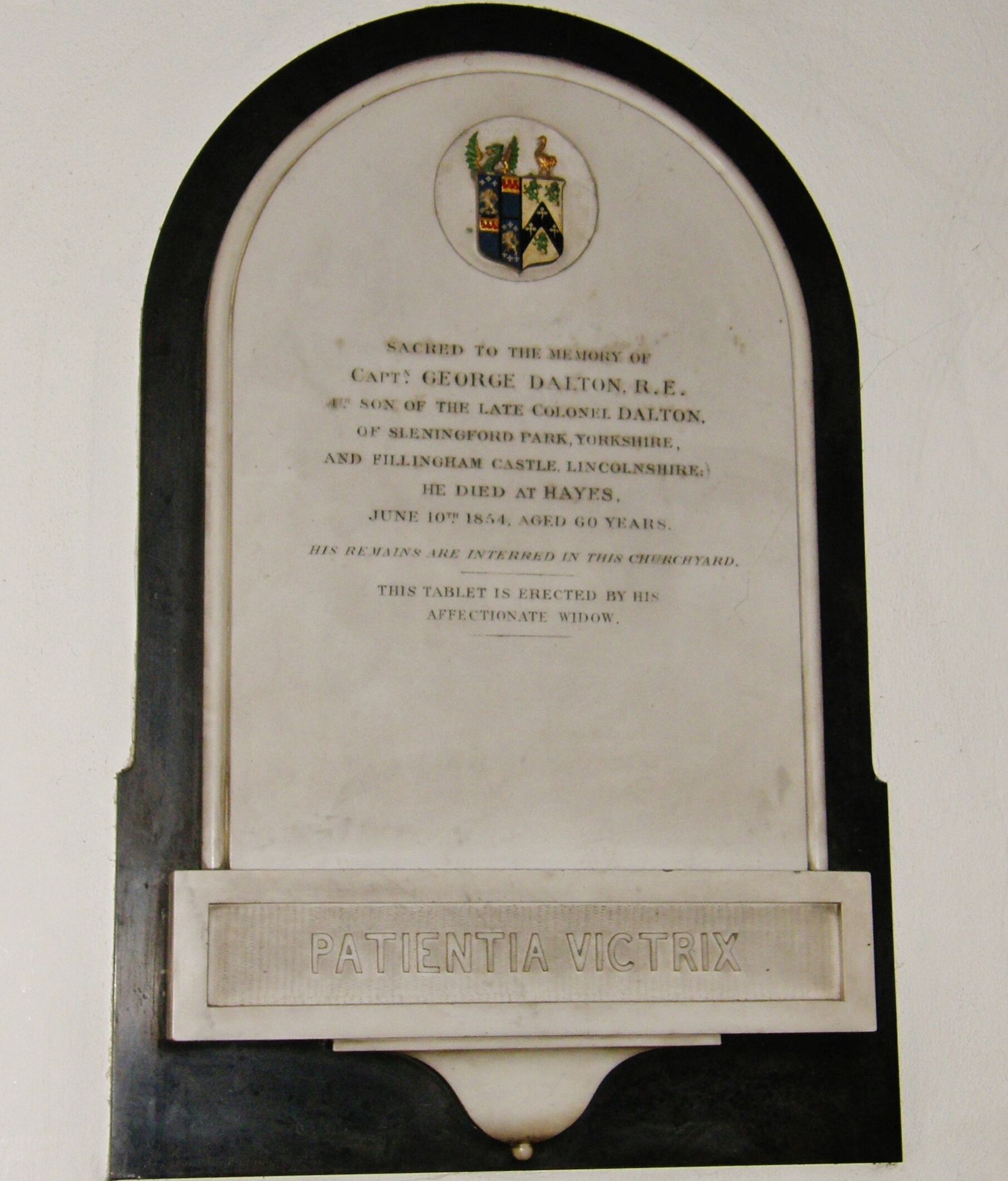
When Captain George Dalton died in 1854, the Victorian renovations at St Johns had only just been completed a few years before. At that time, some of the memorial tablets were moved from the central aisle out to the side aisles and I think it must have been fortunate that there was a space for one more to remember Captain George. It was no longer the practise of burying the dead in vaults under the floor of the church and so Captain George is one of the few that have a memorial inside as well as a gravestone outside.
George Dalton was born in 1704, the fourth son of John Dalton a wealthy landowner who owned Sleningford Park in Yorkshire and Fillingham Castle Lincolnshire (this building is now derelict and if you search online there are some amazing photos). George was a captain in the Royal Engineers. He married Euphemia Caulfield Hannington in 1829 but I cannot find a record of any children. In the 1851 census, George and Euphemia were living with their 3 servants at Hayes End House, White Hart Road, Hayes End. By looking at the online map collection on the National Library of Scotland website, I have discovered that White Hart Road is now called Hayes End Road.
George died aged 60 in 1854, and in his will he left all his possessions to his wife. The executors of his will were John Dalton, (George’s brother) and William Sullivan, a Lieutenant Colonel in the Army, presumably a close friend of George. It seems that Euphemia didn’t stay in Hillingdon as only 10 months later she married again with her address given as Hanover Square. And the man she married? Well, it was William Sullivan, George’s executor. Euphemia died in 1877 and is buried in Ryde Churchyard on the Isle of Wight.
And finally, here is a bit of trivia for you. Perhaps some of you remember the White Hart pub (now demolished) on the Uxbridge Road at Hayes End near to where George & Euphemia lived. In 1393, during the reign of King Richard II, an Act was passed which made it compulsory for pubs and inns to have a sign in order to identify them as official watering holes. Many adopted The White Hart as their sign as it was the personal badge of the King – today it is the fourth most popular pub name in the UK.
Christine Bartlett
